
NG Tube Insertion

An NG tube insertion procedure involves guiding a thin flexible tube into a patient’s stomach through the nostrils and esophagus. MedVR Education, through its VR clinical solutions, enables nurses to practice this essential nursing skill in a simulated environment with a virtual patient. Hands-on practice ensures a thorough learning session. The photo-realistic setup creates a real-world scenario helping learners better associate with the environment.
Accreditation Statement:
This activity has been planned and implemented in accordance with the accreditation requirements and policies of the Accreditation Council for Continuing Medical Education (ACCME) through the joint providership of Eastern Virginia Medical School, Axon Park, MedVR Education, and the Sentara Center for Simulation and Immersive Learning (SCSIL). Eastern Virginia Medical School is accredited by the ACCME to provide continuing medical education for physicians.
Credit Designation: Eastern Virginia Medical School designates this Other activity (virtual reality and simulation) for a maximum of 1.0 AMA PRA Category1 Credits™. Physicians should claim only the credit commensurate with the extent of their participation in the activity.
Developed in alignment with Merck Manual, How To Insert a Nasogastric Tube by Zubair Malik, MD, Lewis Katz School of Medicine at Temple University.
Core Skills Training

For a patient, having a tube inserted into the nostril to be guided down the esophagus into the stomach can be a difficult procedure. It is the job of the practicing nurse to put the patient at ease and be prepared. As part of the Patient Preparation lesson, learners practice gathering required material, performing hand hygiene, informing the patient of the procedure, adjusting the bed height, examining the nostrils, and lubricating the tube for insertion. Detailed instructions are provided throughout the lesson for complete understanding.
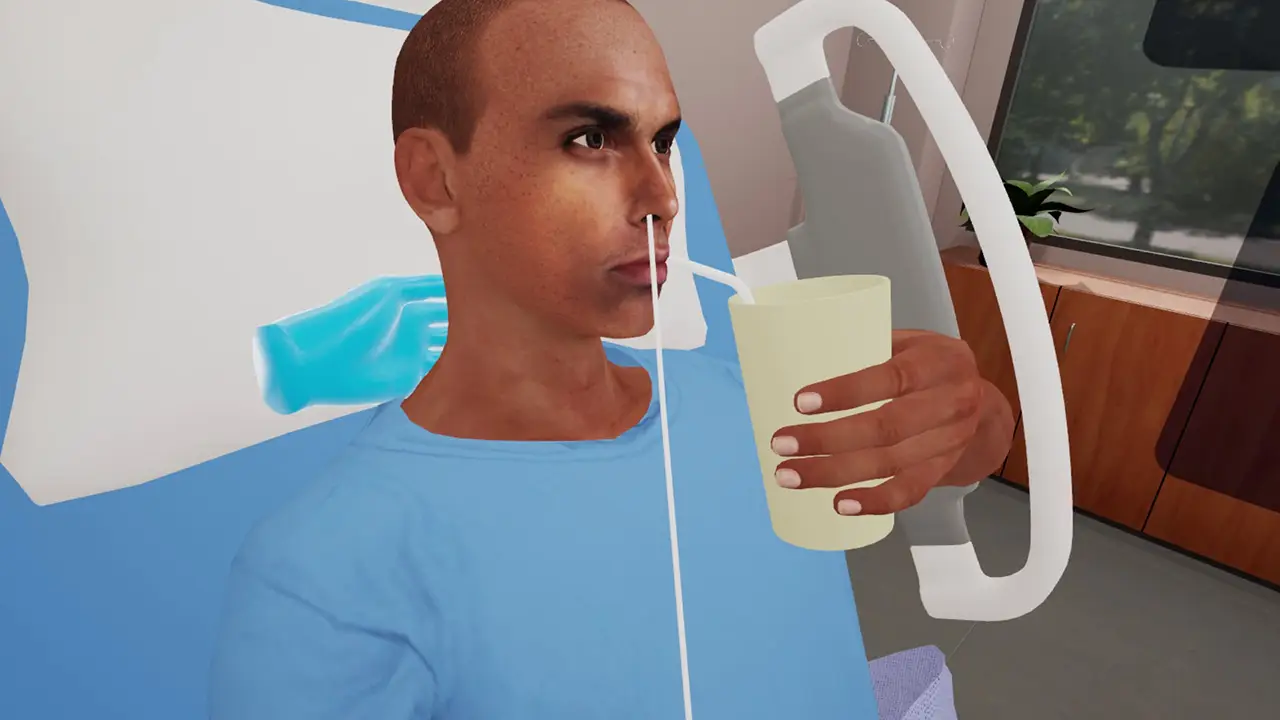
Having gathered all the material and informed the patient of the procedure, the nurse is required to complete the insertion procedure. As part of this lesson, learners perform tasks like inserting the tube, instructing the patient to take small sips of water, checking correct placement of the tube, performing the ‘whoosh’ test, and securing the tube to the patient’s nose. Learners are helped with detailed instructions at every step of the process. Physics-based interactions and haptic feedback provide real-world like experiences, helping learners gain a better understanding of their performance and effects of their actions. Instant feedback helps identify mistakes and instantly rectify them.
Training
With prompts, guidance and affordances learners are hand-held through the process to practice the procedure in a virtual environment with a virtual patient.

Photorealistic Virtual Environment
Physics-based Interactions
Learn by Doing
Visual Affordances

Assessment
Test skills to perform the procedures from start to finish without prompts. An incorrect step will take the learner back to the start to start afresh.

Live Scoring
Instant Feedback
Unlimited Practice Sessions
LMS Integration
