Clinical Simulation
Substance Use Disorder
About This Course
What you'll experience
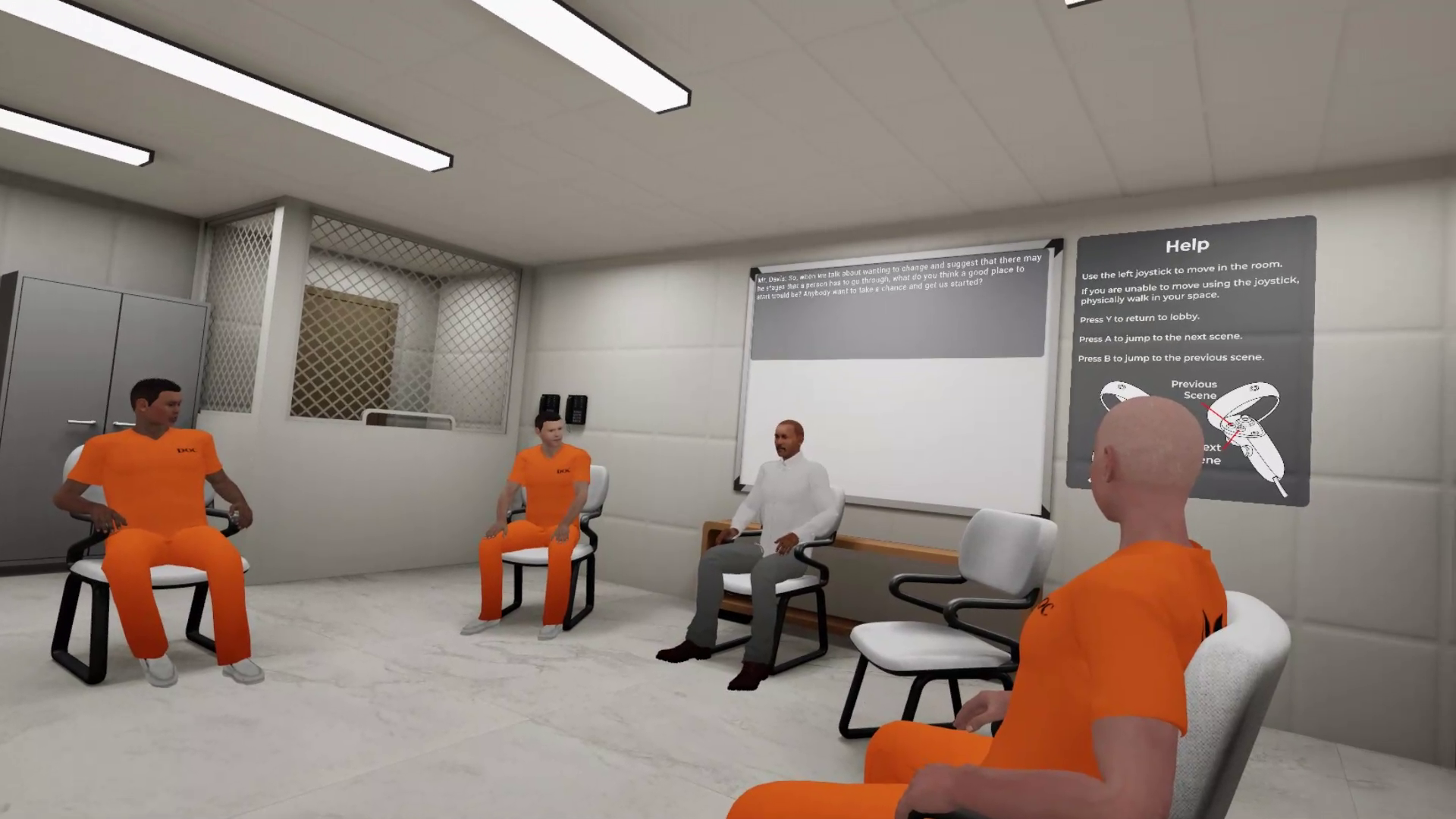
Utilizing a VR format, the Stages of Change Substance Use Disorder (SUD) treatment program guides users through an interactive experience. It focuses on working with participants to develop skills necessary to create a positive and productive intervention for those early in SUD treatment. This group treatment is conducted in a correctional setting in which the facilitator, Mr. Davis, guides the participants through each stage of change by applying their past experiences to their current SUD treatment needs. Participants are expected to use attentive listening skills, objectivity, and open-mindedness. Stages of Change is also designed to introduce terms and concepts utilized throughout the treatment process. Finally, Stages of Change begins the process of collaborating with participants to identify areas of motivation that can enhance their change efforts, while identifying characteristics that make up their “Barriers” to change. Stages of Change of the SUD program uses a cognitively-based intervention to assist participants in identifying distorted thoughts and beliefs. The core of the Stages of Change intervention is drawn from the Transtheoretical Model.
Learning Objectives
- Learn about the Stages of Change
- Assess current level of engagement to identify personal stage of change
- Acquire beginner’s knowledge of “Barriers” to treatment
- Learn about the criteria associated with addictive use of alcohol and/or other drugs
- Acquire working knowledge of the neuropsychology of “Habits”
References
- Prochaska, J. O., Norcross, J. C., & DiClemente, C. C. (2013). Applying the stages of change. Psychotherapy in Australia, 19(2), 10–15. https://search.informit.org/doi/10.3316/informit.254435778545597
- American Addiction Centers (2022). CAGE Questionnaire (4 Questions to Screen for Alcoholism), Information obtained from https://americanaddictioncenters.org/alcoholism-treatment/cage-questionnaire-assessment.
- National Institute on Alcohol Abuse and Alcoholism, (2003). Assessing Alcohol Problems: A Guide for Clinicians and Researchers, 2d ed. NIH Pub. No. 03–3745, Washington, DC: U.S. Dept. of Health and Human Services, Public Health Service. http://pubs.niaaa.nih.gov/publications/AssessingAlcohol/index.htm.)
- Tsamitros, N., Sebold, M., Gutwinski, S., & Beck, A. (2021). Virtual Reality-Based Treatment Approaches in the Field of Substance Use Disorders. Current Addiction Reports, 8(3), 399-407.
- Bohil CJ, Alicea B, Biocca FA (2011) Virtual reality in neuroscience research and therapy. Nat Rev Neurosci 12:752–762. doi:10.1038/nrn3122
What you'll practice
Core Skills Training

Core Skill
Precontemplation
In this stage, people do not intend to take action in the foreseeable future (defined as within the next 6 months). People are often unaware that their behavior is problematic or produces negative consequences. In this stage, people often underestimate the pros of changing behavior and place too much emphasis on the cons of changing behavior.

Get started
Ready to transform clinical training?
Book a demo to see Substance Use Disorder and our full simulation library in action.