Virtual Reality Medical Simulation
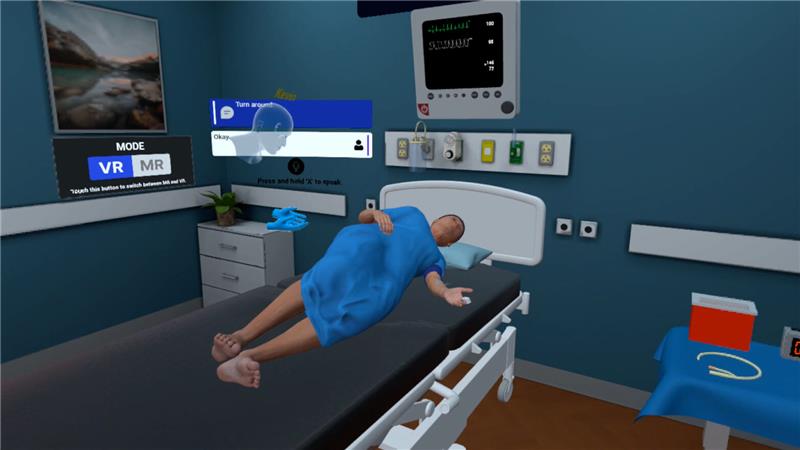
Virtual Reality (VR) medical simulation is one of the most effective and scalable methods for developing clinical skills in modern healthcare education. Because patient safety is paramount, hands-on practice in controlled, risk-free environments is essential. While traditional tools such as mannequins and cadavers continue to play an important role, VR medical simulation is transforming how healthcare professionals are trained, improving access, standardization, and learning outcomes.
VR medical simulations place learners inside highly immersive, three-dimensional clinical environments where they can practice procedures, make decisions, and interact with virtual patients and equipment as they would in real-world settings. With the integration of haptic feedback and realistic environmental design, VR training delivers an unparalleled level of experiential learning.
VR medical simulations place learners inside highly immersive, three-dimensional clinical environments where they can practice procedures, make decisions, and interact with virtual patients and equipment as they would in real-world settings. With the integration of haptic feedback and realistic environmental design, VR training delivers an unparalleled level of experiential learning.
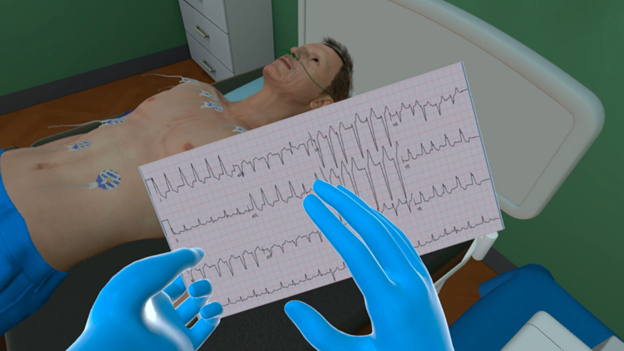
Applications of Virtual Reality Medical Simulation
VR medical simulation can be applied across nearly every department in a healthcare system. It supports skill development, confidence building, and competency validation while addressing growing workforce demands and training constraints.
Surgery:
Surgical practice requires precision, composure under pressure, and extensive repetition. VR allows surgeons and trainees to rehearse procedures repeatedly in zero-risk environments, refining both technical skills and decision-making without jeopardizing patient safety.
Physicians:
VR environments with virtual patients enable physicians to practice clinical reasoning, history-taking, diagnosis, and patient communication. Learners encounter diverse patient presentations and conditions, helping prepare them for real-world clinical variability and complexity.
Nursing:
Nurses are the backbone of patient care and require consistent, high-quality training. VR medical simulation supports scalable skill development without the need for large physical simulation labs. Multiple learners can train simultaneously, repeat scenarios as needed, and build confidence before entering real clinical settings.
Allied Healthcare:
Allied health professionals including phlebotomists, radiologic technologists, sonographers, physical therapy aides, sterile processing technicians, and others perform critical tasks that directly impact patient outcomes. VR provides repeated procedural practice in a safe environment, ensuring technical accuracy and procedural confidence before live clinical application.
Medical Equipment Handling:
Healthcare professionals must safely operate a wide range of complex medical devices. VR enables staff to learn proper handling, maintenance, and troubleshooting without risking damage to expensive equipment or compromising clinical operations.
Soft Skills and Communication:
Clinical success depends not only on technical skill, but also on communication, empathy, teamwork, and professionalism. VR simulations with virtual humans allow learners to practice patient interaction, conflict management, teamwork, and situational awareness across both routine and high-stress scenarios.
Continuing Professional Development:
Healthcare is constantly evolving. New technologies, protocols, and treatments require ongoing education. VR medical simulation supports continuous learning by allowing professionals to refresh existing skills, learn new techniques, and stay current—on their own schedules and without disrupting clinical workflows.
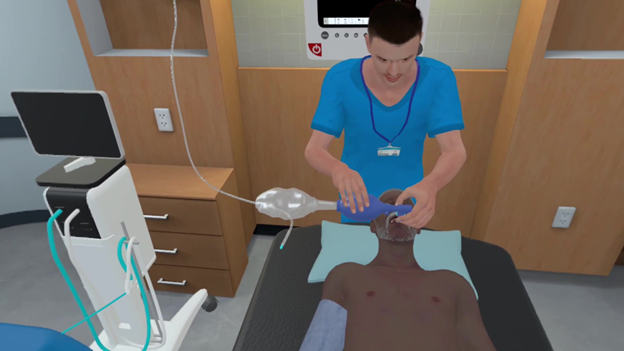
Why Virtual Reality Medical Simulation Matters
Clinical simulation is the cornerstone of effective healthcare training, yet traditional simulation is resource-intensive, costly, and often limited by space, staffing, and scheduling. VR medical simulation overcomes these barriers by offering:
● Immersive, Realistic Training: Learners practice in highly realistic virtual clinical environments.
● Hands-On Skill Development: Procedural and decision-making skills are built through active participation.
● Risk-Free Practice: High-risk scenarios can be practiced safely with no danger to patients or staff.
● Repeatable and Scalable Training: Scenarios can be repeated without wear-and-tear or added cost.
● Flexible Access: Training is not bound by location or time constraints.
● Cost Efficiency: Eliminates the need for large physical labs, consumables, and recurring equipment replacement.
VR makes clinical training more accessible, scalable, and safe by replacing resource-heavy simulations with immersive, repeatable virtual practice.
● Hands-On Skill Development: Procedural and decision-making skills are built through active participation.
● Risk-Free Practice: High-risk scenarios can be practiced safely with no danger to patients or staff.
● Repeatable and Scalable Training: Scenarios can be repeated without wear-and-tear or added cost.
● Flexible Access: Training is not bound by location or time constraints.
● Cost Efficiency: Eliminates the need for large physical labs, consumables, and recurring equipment replacement.
VR makes clinical training more accessible, scalable, and safe by replacing resource-heavy simulations with immersive, repeatable virtual practice.
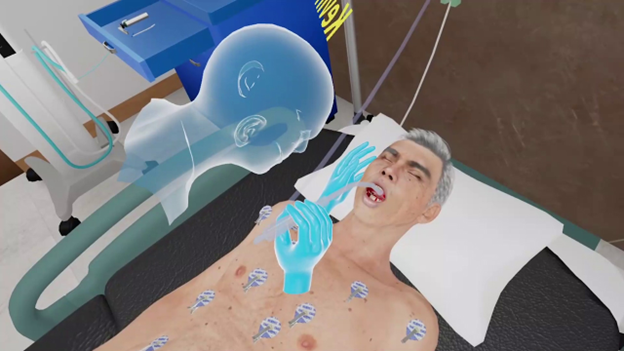
Advancing Healthcare Training with VR
Virtual reality medical simulation enables healthcare institutions to deliver standardized, high-quality training at scale. By combining immersive environments, repeatable practice, and objective performance assessment, VR helps learners build both technical competence and clinical confidence.
At MedVR Education, our VR medical simulations are designed to support learners across the full spectrum of healthcare education from students to experienced clinicians ensuring they are prepared to deliver safe, effective, and compassionate care in real-world clinical environments.
At MedVR Education, our VR medical simulations are designed to support learners across the full spectrum of healthcare education from students to experienced clinicians ensuring they are prepared to deliver safe, effective, and compassionate care in real-world clinical environments.